


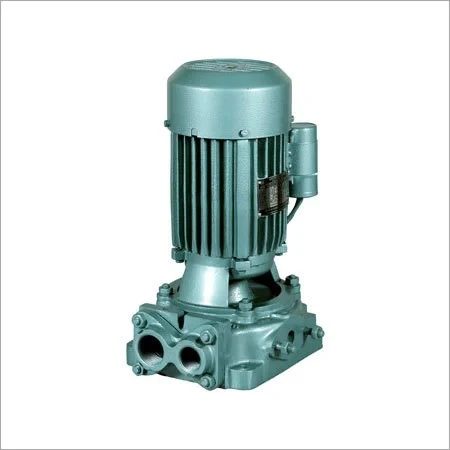
Vertical Inline Pump
Industrial Vertical Inline Centrifugal Pumps
Vertical inline pumps integrate suction and discharge connections on a single centerline, reducing spatial footprint by up to 50% compared to end-suction configurations. Designed for closed-loop HVAC, municipal water circulation, and pressure boosting systems, these units eliminate traditional concrete inertia bases by utilizing rigid inline pipe support.
Technical Specifications & Performance Range
|
Parameter |
Standard Range / Specification |
|
Flow Rate (Q) |
10 to 1,500 GPM (2.5 to 340 m3/h) |
|
Head (TDH) |
Up to 400 feet (122 meters) |
|
Motor Output |
0.75 HP to 125 HP (0.55 kW to 90 kW) |
|
Operating Speed |
1,750 RPM / 3,500 RPM (60Hz) or 1,450 RPM / 2,900 RPM (50Hz) |
|
Max Working Pressure |
175 PSI to 300 PSI (1.2 MPa to 2.1 MPa) |
|
Fluid Temperature Range |
-20C to 120C (-4F to 248F) |
|
Flange Connections |
ANSI B16.5 Class 150 / DIN PN16 / PN25 Drilled |
Material & Metallurgical Options
Selecting the correct metallurgy prevents galvanic corrosion and ensures compatibility with treated water, glycol solutions, or mild chemicals.
Pump Casing: Cast Iron (ASTM A48 Class 30B / EN-GJL-250) standard; Ductile Iron (ASTM A536) for high-pressure systems; 316 Stainless Steel for corrosive media.
Impeller: 304 or 316 Stainless Steel (precision laser-welded or investment cast); Bronze (ASTM B584 C83600) for marine and specific municipal applications.
Shaft: 420 Stainless Steel (standard heavy-duty torque transmission) or 316 Stainless Steel.
Mechanical Seal: Carbon / Silicon Carbide (SiC) faces with Viton elastomers as standard. Tungsten carbide options available for abrasive fluid duties.
Manufacturing & Quality Control
Our manufacturing facility utilizes CNC vertical machining centers to maintain strict coaxial tolerance between the motor mounting bracket and the pump casing bore, minimizing operational vibration.
Casting Inspection: Ultrasonic testing and dimensional coordinate measuring machine (CMM) checks on incoming volute castings.
Dynamic Balancing: Impellers are dynamically balanced to ISO 1940 Grade 6.3 standards prior to final rotor assembly.
Hydrostatic Testing: Every assembled pump casing undergoes a shell test at 1.5 times the maximum rated working pressure for 10 minutes prior to paint application.
Performance Testing: Automated test benches record flow, head, power consumption, and NPSHr in accordance with ISO 9906 Grade 2B tolerances. Test certificates are supplied with every serialized unit.
Application Matrix & Selection Guide
|
Application |
Recommended Configuration |
Key Considerations |
|
Commercial HVAC Closed Loops |
Cast Iron casing, 304 SS impeller, mechanical seal rated to 120C |
Low noise vibration levels; must handle 30% to 50% glycol mixtures. |
|
Municipal Booster Stations |
Ductile Iron casing, bronze or SS impeller, 300 PSI rating |
Continuous 24/7 duty cycle; high static head tolerance. |
|
Industrial Cooling Towers |
Cast Iron body, stainless steel fitted components |
Resistance to water treatment chemicals and suspended solids. |
Frequently Asked Questions
Q: Do vertical inline pumps require a concrete foundation pad?
A: No. Because suction and discharge ports share the same axis and elevation, the piping system supports the structural weight of smaller units. For motors exceeding 15 HP, structural pipe hangers or localized inertia bases are recommended to absorb external piping thermal expansion forces, but heavy concrete pads are unnecessary.
Q: How do you prevent mechanical seal failure during initial system flushing?
A: System construction debris (welding slag, pipe scale, sand) destroys mechanical seal faces during startup. We supply temporary fine-mesh startup strainers and recommend flushing closed loops prior to installing final operational mechanical seals. Internal flush lines with optional cyclone separators can also be specified for particle-laden environments.
Q: What is the standard motor enclosure and efficiency rating?
A: Standard configurations utilize TEFC (Totally Enclosed Fan Cooled) or ODP (Open Drip Proof) motors meeting IE3 (IEC) or NEMA Premium Efficiency standards. Explosion-proof motors (Class I, Division 1 or ATEX certified) are available for petrochemical and specialized industrial environments.
Q: Can these pumps be installed in a horizontal piping orientation?
A: No. Vertical inline pumps are engineered specifically for vertical motor-up installation. Mounting the motor horizontally introduces eccentric gravitational loads on the shaft and bearings, leading to premature mechanical seal failure and shaft deflection.
Q: What documentation is provided with shipment?
A: Each pump ships with a complete technical submittal package including certified dimensional outline drawings, ISO 9906 individual performance curves, Material Test Reports (MTRs) for wetted components, and an installation, operation, and maintenance (IOM) manual.
Q: What is the typical lead time for standard configurations?
A: Standard cast iron models with ANSI/DIN flanges ship within 3 to 5 business days for regional warehouse stock. Engineered-to-order configurations requiring specialized mechanical seals or 316 stainless steel metallurgy typically require 4 to 6 weeks of production lead time.
Hot Tags: vertical inline pump, China vertical inline pump manufacturers, suppliers, factory
Previous
Vertical Long Shaft PumpYou Might Also Like



Send Inquiry